MODFLOW 6 version 6.9.0.dev0
USGS Modular Hydrologic Model
Loading...
Searching...
No Matches
svdmodule Module Reference

Functions/Subroutines

pure real(dp) function, dimension(:, :), allocatable house_holder_matrix (x)
pure subroutine, public bidiagonal_decomposition (a, p, qt)
pure real(dp) function, dimension(2, 2) givens_rotation (a, b)
pure real(dp) function compute_shift (a)
pure subroutine, public bidiagonal_qr_decomposition (a, u, vt)
pure subroutine handle_zero_diagonal (a, u, vt)
pure real(dp) function superdiagonal_norm (a)
pure subroutine find_nonzero_superdiagonal (a, p, q)
pure logical(lgp) function has_zero_diagonal (a)
pure subroutine make_matrix_square (a, qt)
pure subroutine clean_superdiagonal (a)
pure subroutine, public svd (a, u, s, vt)
 Singular Value Decomposition.

Function/Subroutine Documentation

◆ bidiagonal_decomposition()

pure subroutine, public svdmodule::bidiagonal_decomposition ( real(dp), dimension(:, :), intent(inout) a,
real(dp), dimension(:, :), intent(out), allocatable p,
real(dp), dimension(:, :), intent(out), allocatable qt )

Definition at line 64 of file SingularValueDecomposition.f90.

65 ! -- dummy
66 real(DP), intent(inout), dimension(:, :) :: A
67 real(DP), intent(out), dimension(:, :), allocatable :: P, Qt
68 ! -- locals
69 integer(I4B) :: M, N
70 integer(I4B) :: I
71 real(DP), allocatable, dimension(:, :) :: Qi, Pi
72 real(DP), allocatable, dimension(:) :: h
73
74 m = size(a, dim=1) ! Number of rows
75 n = size(a, dim=2) ! Number of columns
76
77 qt = eye(n)
78 p = eye(m)
79
80 do i = 1, min(m, n)
81 ! columns
82 h = a(i:m, i)
83 pi = house_holder_matrix(h)
84 a(i:m, :) = matmul(pi, a(i:m, :)) ! Apply householder transformation from left
85 p(:, i:m) = matmul(p(:, i:m), pi)
86
87 ! rows
88 if (i < n) then
89 h = a(i, i + 1:n)
90 qi = transpose(house_holder_matrix(h))
91 a(:, i + 1:n) = matmul(a(:, i + 1:n), qi) ! Apply householder transformation from right
92 qt(i + 1:n, :) = matmul(qi, qt(i + 1:n, :))
93 end if
94
95 end do
96
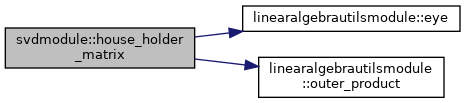
Here is the call graph for this function:
Here is the caller graph for this function:

◆ bidiagonal_qr_decomposition()

pure subroutine, public svdmodule::bidiagonal_qr_decomposition ( real(dp), dimension(:, :), intent(inout) a,
real(dp), dimension(:, :), intent(inout) u,
real(dp), dimension(:, :), intent(inout) vt )

Definition at line 183 of file SingularValueDecomposition.f90.

184 ! -- dummy
185 real(DP), intent(inout), dimension(:, :) :: A
186 real(DP), intent(inout), dimension(:, :) :: U, Vt
187 ! -- locals
188 integer(I4B) :: m, n, I, J
189 real(DP), dimension(2, 2) :: G
190 real(DP) :: t11, t12, mu
191
192 m = size(a, dim=1) ! Number of rows
193 n = size(a, dim=2) ! Number of columns
194
195 DO i = 1, n - 1
196 j = i + 1
197 if (i == 1) then
198 ! For the first iteration use the implicit shift
199 mu = compute_shift(a)
200 ! Apply the shift to the full tri-diagonal matrix.
201 t11 = a(1, 1)**2 - mu
202 t12 = a(1, 1) * a(1, 2)
203
204 g = givens_rotation(t11, t12)
205 else
206 g = givens_rotation(a(i - 1, i), a(i - 1, j))
207 end if
208
209 a(:, i:j) = matmul(a(:, i:j), transpose(g))
210 vt(i:j, :) = matmul(g, vt(i:j, :))
211
212 if (j > m) cycle
213 g = givens_rotation(a(i, i), a(j, i))
214 a(i:j, :) = matmul(g, a(i:j, :))
215 u(:, i:j) = matmul(u(:, i:j), transpose(g))
216 END DO
217
Here is the call graph for this function:
Here is the caller graph for this function:

◆ clean_superdiagonal()

pure subroutine svdmodule::clean_superdiagonal ( real(dp), dimension(:, :), intent(inout) a)
private

Definition at line 385 of file SingularValueDecomposition.f90.

386 ! -- dummy
387 real(DP), intent(inout), dimension(:, :) :: A
388 ! -- locals
389 integer(I4B) :: n, m, j
390
391 m = size(a, dim=1) ! Number of rows
392 n = size(a, dim=2) ! Number of columns
393
394 do j = 1, min(n, m) - 1
395 if (abs(a(j, j + 1)) <= dprec * (abs(a(j, j)) + abs(a(j + 1, j + 1)))) then
396 a(j, j + 1) = 0.0_dp
397 end if
398 end do
399
Here is the caller graph for this function:

◆ compute_shift()

pure real(dp) function svdmodule::compute_shift ( real(dp), dimension(:, :), intent(in) a)
private

Definition at line 135 of file SingularValueDecomposition.f90.

136 ! -- dummy
137 real(DP), intent(in), dimension(:, :) :: A
138 real(DP) :: mu
139 ! -- locals
140 integer(I4B) :: m, n, min_mn
141 real(DP) T11, T12, T21, T22
142 real(DP) dm, fmmin, fm, dn
143 real(DP) :: mean, product, mean_product, mu1, mu2
144
145 m = size(a, dim=1) ! Number of rows
146 n = size(a, dim=2) ! Number of columns
147
148 min_mn = min(m, n)
149
150 dn = a(min_mn, min_mn)
151 dm = a(min_mn - 1, min_mn - 1)
152 fm = a(min_mn - 1, min_mn)
153 if (min_mn > 2) then
154 fmmin = a(min_mn - 2, min_mn - 1)
155 else
156 fmmin = 0.0_dp
157 end if
158
159 t11 = dm**2 + fmmin**2
160 t12 = dm * fm
161 t21 = t12
162 t22 = fm**2 + dn**2
163
164 mean = (t11 + t22) / 2.0_dp
165 product = t11 * t22 - t12 * t21
166 mean_product = mean**2 - product
167 if (abs(mean_product) < dem6) then
168 mean_product = 0.0_dp
169 end if
170 mu1 = mean - sqrt(mean_product)
171 mu2 = mean + sqrt(mean_product)
172 if (abs(t22 - mu1) < abs(t22 - mu2)) then
173 mu = mu1
174 else
175 mu = mu2
176 end if
177
Here is the caller graph for this function:

◆ find_nonzero_superdiagonal()

pure subroutine svdmodule::find_nonzero_superdiagonal ( real(dp), dimension(:, :), intent(in) a,
integer(i4b), intent(out) p,
integer(i4b), intent(out) q )
private

Definition at line 296 of file SingularValueDecomposition.f90.

297 ! -- dummy
298 real(DP), intent(in), dimension(:, :) :: A
299 integer(I4B), intent(out) :: p ! Index of the first nonzero superdiagonal (start of active block)
300 integer(I4B), intent(out) :: q ! Index of the last nonzero superdiagonal (end of active block)
301 ! -- locals
302 integer(I4B) :: m, n, j, min_mn
303
304 m = size(a, dim=1) ! Number of rows
305 n = size(a, dim=2) ! Number of columns
306
307 min_mn = min(m, n)
308 p = 1
309 q = min_mn
310
311 do j = min_mn, 2, -1
312 if (abs(a(j - 1, j)) > dprec) then
313 q = j
314 exit
315 end if
316 end do
317
318 do j = q - 1, 2, -1
319 if (abs(a(j - 1, j)) < dprec) then
320 p = j
321 exit
322 end if
323 end do
Here is the caller graph for this function:

◆ givens_rotation()

pure real(dp) function, dimension(2, 2) svdmodule::givens_rotation ( real(dp), intent(in) a,
real(dp), intent(in) b )
private

Definition at line 102 of file SingularValueDecomposition.f90.

103 ! -- dummy
104 real(DP), intent(in) :: a, b
105 real(DP), dimension(2, 2) :: G
106 ! -- locals
107 real(DP) :: c, s, h, d
108
109 if (abs(b) < dprec) then
110 g = eye(2)
111 return
112 end if
113
114 h = hypot(a, b)
115 d = 1.0 / h
116 c = abs(a) * d
117 s = sign(d, a) * b
118
119 g(1, 1) = c
120 g(1, 2) = s
121 g(2, 1) = -s
122 g(2, 2) = c
123
Here is the call graph for this function:
Here is the caller graph for this function:

◆ handle_zero_diagonal()

pure subroutine svdmodule::handle_zero_diagonal ( real(dp), dimension(:, :), intent(inout) a,
real(dp), dimension(:, :), intent(inout) u,
real(dp), dimension(:, :), intent(inout) vt )
private

Definition at line 230 of file SingularValueDecomposition.f90.

231 ! -- dummy
232 real(DP), intent(inout), dimension(:, :) :: A
233 real(DP), intent(inout), dimension(:, :) :: U, Vt
234 ! -- locals
235 integer(I4B) :: m, n, I
236 real(DP), dimension(2, 2) :: G
237 integer(I4B) :: zero_index
238
239 m = size(a, dim=1) ! Number of rows
240 n = size(a, dim=2) ! Number of columns
241
242 do i = 1, min(m, n)
243 if (abs(a(i, i)) < dprec) then
244 zero_index = i
245 exit
246 end if
247 end do
248
249 if (zero_index == min(n, m)) then
250 ! If the zero index is the last element of the diagonal then zero out the column
251 do i = zero_index - 1, 1, -1
252 g = givens_rotation(a(i, i), a(i, zero_index))
253 a(:, [i, zero_index]) = matmul(a(:, [i, zero_index]), transpose(g))
254 vt([i, zero_index], :) = matmul(g, vt([i, zero_index], :))
255 end do
256 else
257 ! Else zero out the row
258 do i = zero_index + 1, n
259 g = givens_rotation(a(i, i), a(zero_index, i))
260 a([zero_index, i], :) = matmul(transpose(g), a([zero_index, i], :))
261 u(:, [zero_index, i]) = matmul(u(:, [zero_index, i]), g)
262 end do
263 end if
Here is the call graph for this function:
Here is the caller graph for this function:

◆ has_zero_diagonal()

pure logical(lgp) function svdmodule::has_zero_diagonal ( real(dp), dimension(:, :), intent(in) a)
private

Definition at line 329 of file SingularValueDecomposition.f90.

330 ! -- dummy
331 real(DP), intent(in) :: A(:, :)
332 logical(LGP) :: has_zero
333 ! -- locals
334 integer(I4B) :: m, n, I
335
336 m = size(a, dim=1) ! Number of rows
337 n = size(a, dim=2) ! Number of columns
338
339 has_zero = .false.
340 do i = 1, min(m, n)
341 if (abs(a(i, i)) < dprec) then
342 has_zero = .true.
343 exit
344 end if
345 end do
346
Here is the caller graph for this function:

◆ house_holder_matrix()

pure real(dp) function, dimension(:, :), allocatable svdmodule::house_holder_matrix ( real(dp), dimension(:), intent(in) x)
private

Definition at line 18 of file SingularValueDecomposition.f90.

19 ! -- dummy
20 real(DP), intent(in) :: x(:)
21 real(DP), allocatable, dimension(:, :) :: Q
22 ! -- locals
23 real(DP) :: x_norm, y_norm
24 real(DP), allocatable :: v(:)
25 real(DP), allocatable :: w(:)
26
27 x_norm = norm2(x)
28 y_norm = norm2(x(2:))
29
30 q = eye(size(x))
31
32 if (dabs(y_norm) < dsame) then
33 return
34 end if
35
36 v = x
37 if (x(1) > 0) then
38 ! Parlett (1971) suggested this modification to avoid cancellation
39 v(1) = -(y_norm**2) / (x(1) + x_norm)
40 else
41 v(1) = v(1) - x_norm
42 end if
43
44 w = v / norm2(v)
45
46 q = q - 2.0_dp * outer_product(w, w)
47
Here is the call graph for this function:
Here is the caller graph for this function:

◆ make_matrix_square()

pure subroutine svdmodule::make_matrix_square ( real(dp), dimension(:, :), intent(inout) a,
real(dp), dimension(:, :), intent(inout), allocatable qt )
private

Definition at line 355 of file SingularValueDecomposition.f90.

356 ! -- dummy
357 real(DP), intent(inout), dimension(:, :) :: A
358 real(DP), intent(inout), dimension(:, :), allocatable :: Qt
359 ! -- locals
360 real(DP), dimension(2, 2) :: G
361 integer(I4B) :: m, n, I
362
363 m = size(a, dim=1) ! Number of rows
364 n = size(a, dim=2) ! Number of columns
365
366 do i = m, 1, -1
367 g = givens_rotation(a(i, i), a(i, m + 1))
368 a(:, [i, m + 1]) = matmul(a(:, [i, m + 1]), transpose(g))
369 qt([i, m + 1], :) = matmul(g, qt([i, m + 1], :))
370 end do
371
Here is the call graph for this function:
Here is the caller graph for this function:

◆ superdiagonal_norm()

pure real(dp) function svdmodule::superdiagonal_norm ( real(dp), dimension(:, :), intent(in) a)
private

Definition at line 269 of file SingularValueDecomposition.f90.

270 ! -- dummy
271 real(DP), intent(in) :: A(:, :)
272 real(DP) :: norm
273 ! -- locals
274 integer(I4B) :: m, n, I
275
276 m = size(a, dim=1) ! Number of rows
277 n = size(a, dim=2) ! Number of columns
278
279 norm = 0.0_dp
280 do i = 1, min(m, n) - 1
281 norm = max(norm, abs(a(i, i + 1)))
282 end do
283
Here is the caller graph for this function:

◆ svd()

pure subroutine, public svdmodule::svd ( real(dp), dimension(:, :), intent(in) a,
real(dp), dimension(:, :), intent(out), allocatable u,
real(dp), dimension(:, :), intent(out), allocatable s,
real(dp), dimension(:, :), intent(out), allocatable vt )

This method decomposes the matrix A into U, S and VT. It follows the algorithm as described by Golub and Reinsch.

The first step is to decompose the matrix A into a bidiagonal matrix. This is done using Householder transformations. Then second step is to decompose the bidiagonal matrix into U, S and VT by repetitively applying the QR algorithm. If there is a zero on the diagonal or superdiagonal the matrix can be split into two smaller matrices and the QR algorithm can be applied to the smaller matrices.

The matrix U is the eigenvectors of A*A^T The matrix VT is the eigenvectors of A^T*A The matrix S is the square root of the eigenvalues of A*A^T or A^T*A

Definition at line 420 of file SingularValueDecomposition.f90.

421 ! -- dummy
422 real(DP), intent(in), dimension(:, :) :: A
423 real(DP), intent(out), dimension(:, :), allocatable :: U
424 real(DP), intent(out), dimension(:, :), allocatable :: S
425 real(DP), intent(out), dimension(:, :), allocatable :: VT
426 ! -- locals
427 integer(I4B) :: i ! Loop counter for QR iterations
428 integer(I4B) :: max_itr ! Maximum number of QR iterations allowed for convergence
429 real(DP) :: error ! Convergence criterion (superdiagonal norm)
430
431 integer(I4B) :: m ! Number of rows in input matrix A
432 integer(I4B) :: n ! Number of columns in input matrix A
433
434 integer(I4B) :: r ! Start index of active submatrix (for QR step)
435 integer(I4B) :: q ! End index of active submatrix (for QR step)
436
437 max_itr = 100
438
439 m = size(a, dim=1) ! Number of rows
440 n = size(a, dim=2) ! Number of columns
441 s = a
442
443 call bidiagonal_decomposition(s, u, vt)
444
445 if (n > m) then
446 call make_matrix_square(s, vt)
447 end if
448
449 do i = 1, max_itr
450 call find_nonzero_superdiagonal(s, r, q)
451
452 ! find zero diagonal
453 if (has_zero_diagonal(s(r:q, r:q))) then
454 ! write(*,*) 'Iteration: ', i, ' handle zero diagonal element'
455 call handle_zero_diagonal(s(r:q, r:q), u(:, r:q), vt(r:q, :))
456 else
457 call bidiagonal_qr_decomposition(s(r:q, r:q), u(:, r:q), vt(r:q, :))
458 call clean_superdiagonal(s(r:q, r:q))
459
460 error = superdiagonal_norm(s)
461 ! write(*,*) 'Iteration: ', i, ' Error: ', error
462 if (error < dprec) exit
463 end if
464 end do
465
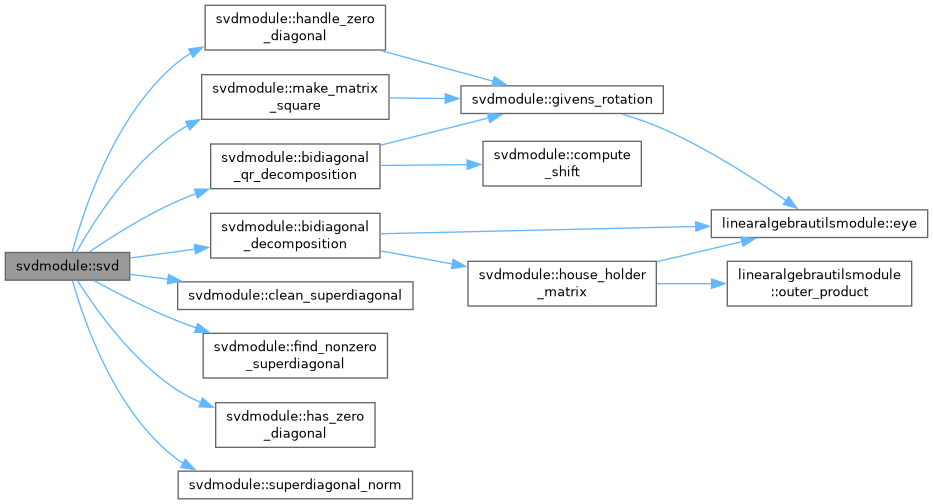
Here is the call graph for this function:
Here is the caller graph for this function: