 |
MODFLOW 6 version 6.9.0.dev0
USGS Modular Hydrologic Model
|
|
MODFLOW 6 version 6.9.0.dev0
USGS Modular Hydrologic Model
|
This class is used to store a single deferred-length character string. It was designed to work in an array implementation so that a jagged character array could be used in MODFLOW and stored in the memory manager. More...

Public Member Functions | |
| procedure, pass(lhs) | assign_to_charstring (lhs, rhs) |
| procedure, pass(rhs) | assign_from_charstring (lhs, rhs) |
| procedure, pass(rhs) | character_eq_charstring (lhs, rhs) |
| procedure, pass(lhs) | charstring_eq_character (lhs, rhs) |
| procedure | charstring_eq_charstring (this, rhs) |
| procedure | write_unformatted (this, unit, iostat, iomsg) |
| procedure | strlen (this) |
| procedure | destroy (this) |
| generic | assignment (lhs, rhs) |
| generic | assignment (lhs, rhs) |
| generic | operator (lhs, rhs) |
| generic | operator (lhs, rhs) |
| generic | operator (this, rhs) |
Private Attributes | |
| character(len=:), allocatable | charstring |
The overloaded methods allow instances to behave like a regular string and work with intrinsic Fortran character strings. Ideas for the implementation were inspired by: https://gitlab.com/everythingfunctional/iso_varying_string
Definition at line 23 of file CharString.f90.
| procedure, pass(rhs) characterstringmodule::characterstringtype::assign_from_charstring | ( | character(len=*), intent(out) | lhs, |
| class(characterstringtype), intent(in) | rhs ) |
Definition at line 28 of file CharString.f90.
| procedure, pass(lhs) characterstringmodule::characterstringtype::assign_to_charstring | ( | class(characterstringtype), intent(out) | lhs, |
| character(len=*), intent(in) | rhs ) |
Definition at line 27 of file CharString.f90.
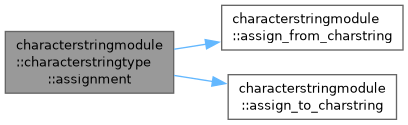
| generic characterstringmodule::characterstringtype::assignment | ( | class(characterstringtype), intent(out) | lhs, |
| character(len=*), intent(in) | rhs ) |
| generic characterstringmodule::characterstringtype::assignment | ( | character(len=*), intent(out) | lhs, |
| class(characterstringtype), intent(in) | rhs ) |
Definition at line 35 of file CharString.f90.
| procedure, pass(rhs) characterstringmodule::characterstringtype::character_eq_charstring | ( | character(len=*), intent(in) | lhs, |
| class(characterstringtype), intent(in) | rhs ) |
Definition at line 29 of file CharString.f90.
| procedure, pass(lhs) characterstringmodule::characterstringtype::charstring_eq_character | ( | class(characterstringtype), intent(in) | lhs, |
| character(len=*), intent(in) | rhs ) |
Definition at line 30 of file CharString.f90.
| procedure characterstringmodule::characterstringtype::charstring_eq_charstring | ( | class(characterstringtype), intent(in) | this, |
| class(characterstringtype), intent(in) | rhs ) |
Definition at line 31 of file CharString.f90.
| procedure characterstringmodule::characterstringtype::destroy | ( | class(characterstringtype), intent(inout) | this | ) |
Definition at line 34 of file CharString.f90.
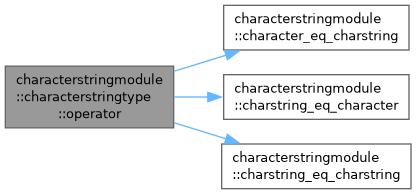
| generic characterstringmodule::characterstringtype::operator | ( | character(len=*), intent(in) | lhs, |
| class(characterstringtype), intent(in) | rhs ) |
| generic characterstringmodule::characterstringtype::operator | ( | class(characterstringtype), intent(in) | lhs, |
| character(len=*), intent(in) | rhs ) |
Definition at line 36 of file CharString.f90.
| generic characterstringmodule::characterstringtype::operator | ( | class(characterstringtype), intent(in) | this, |
| class(characterstringtype), intent(in) | rhs ) |
Definition at line 36 of file CharString.f90.
| procedure characterstringmodule::characterstringtype::strlen | ( | class(characterstringtype), intent(in) | this | ) |
Definition at line 33 of file CharString.f90.
| procedure characterstringmodule::characterstringtype::write_unformatted | ( | class(characterstringtype), intent(in) | this, |
| integer, intent(in) | unit, | ||
| integer, intent(out) | iostat, | ||
| character(len=*), intent(inout) | iomsg ) |
Definition at line 32 of file CharString.f90.
|
private |
Definition at line 25 of file CharString.f90.
 1.18.0